Powder vs Liquid Food Flavor: How to Choose the Right Format for Industrial Food Production
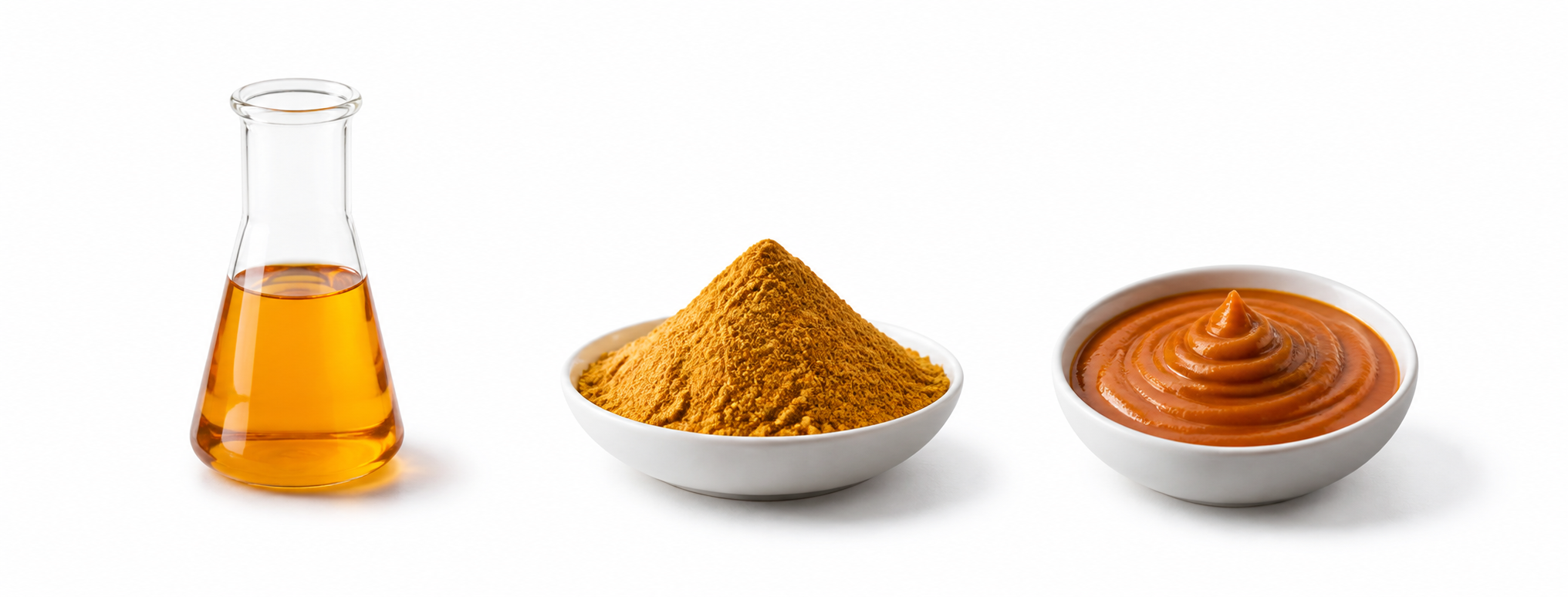
Powder and liquid food flavors can express similar sensory profiles, but they do not behave in the same way during storage, dosing, mixing, heating and consumption. Choosing the wrong format may create weak flavor release, uneven distribution, excessive process loss, handling problems or unnecessary cost.
The decision should therefore begin with the finished product and production process—not with a general preference for powder or liquid.
Short answer: Powder flavors are often well suited to dry blends, seasoning powders, bakery premixes and operations that value easy dry dosing and ambient logistics. Liquid flavors are often preferred when rapid dispersion, precise pumping, oil or water phase compatibility, or strong top-note delivery is important. The correct choice depends on the flavor chemistry, carrier system, food matrix, addition point, thermal load, packaging and target shelf life.
This guide compares both formats and provides a practical factory-testing method for selecting the most suitable option.
Powder and Liquid Flavors Are Delivery Systems
A flavor is not defined only by its aromatic profile. The delivery system determines how the flavor is protected, handled and released.
A powder flavor may be produced by spray drying, adsorption, encapsulation or blending with suitable carriers. A liquid flavor may use water-soluble, oil-soluble, emulsified or other delivery systems. Two products called “chicken flavor” or “vanilla flavor” may therefore differ substantially in concentration, dispersion, carrier declaration, stability and use method.
Do not compare formats by smell alone. Evaluate them at relevant dosage levels in the finished application.
Powder vs Liquid Food Flavor: Quick Comparison
Selection factor | Powder flavor | Liquid flavor |
|---|---|---|
Typical handling | Weighing and dry blending | Pouring, metering or pumping |
Common applications | Seasonings, instant noodles, snacks, dry mixes, bakery premixes | Beverages, sauces, dairy systems, fillings, oils and liquid mixes |
Dispersion | Depends on particle size and carrier | Depends on water/oil solubility or emulsion stability |
Moisture sensitivity | May cake or lose flow if poorly protected | May require leakage and container-compatibility control |
Top-note delivery | Can be protected through encapsulation | Often immediate, depending on system |
Dosing precision | Strong when dry feeders and premixes are controlled | Strong when pumps and small-volume dosing are controlled |
Storage and freight | Often convenient for ambient dry supply | Weight, container and temperature exposure may be more significant |
Label impact | Carrier system must be reviewed | Solvent/carrier/emulsifier system must be reviewed |
This table is directional, not a substitute for product-specific testing.
1. Match the Flavor to the Food Matrix
The first question is where the flavor must distribute.
Water-Based Products
In beverages, broths and some sauces, a water-soluble liquid or properly dispersible powder may be appropriate. Check clarity, sediment, ring formation, turbidity and flavor uniformity after storage.
Fat-Based Products
For frying oils, fat fillings, compound coatings or high-fat sauces, an oil-compatible liquid may disperse more effectively. Some powder systems can also work, but dispersion and visible particles must be evaluated.
Dry Products
Powders are usually practical in seasoning blends, soup powders, bakery premixes and instant noodle sachets because they can be incorporated into a controlled dry blend. Particle size, bulk density, flow and segregation should be considered.
Complex Emulsions
Products containing water, fat, protein, hydrocolloids and emulsifiers may require an emulsion-compatible flavor system. A stable result in a simple tasting solution does not prove stability in the final emulsion.
2. Consider the Addition Point
The same flavor may perform differently depending on when and where it is added.
Ask:
Is the flavor added to a dry preblend, oil phase or water phase?
Is it added before or after heating?
How long is it mixed?
Is there a high-shear step?
Does the process expose the flavor to open-air holding?
Can a small liquid dose be distributed accurately across a large batch?
Can a low-dose powder segregate from other ingredients?
For a dry seasoning plant, adding a small liquid directly into a blender may create local wet spots unless spraying and mixing are controlled. For a beverage line, dissolving a powder may require additional hydration time or filtration. The production system—not the laboratory bench—determines practicality.
3. Evaluate Thermal Processing and Flavor Retention
Heating can change aroma intensity and balance. Volatile notes may be lost, while other components may interact with the food matrix or develop during processing.
Relevant processes include:
baking;
frying;
extrusion;
pasteurization;
UHT processing;
retorting;
hot filling;
cooking and simmering;
spray drying of the finished food system.
Neither “powder” nor “liquid” automatically means better heat stability. Protection depends on composition, carrier, encapsulation, addition point and process exposure.
A practical test should compare the product before processing, immediately after processing and after normal storage. If the profile changes, the answer may be a different flavor system, a revised addition point or a combination of process-stable body notes and later-added top notes.
Mid-article CTA — Ask for an Application-Matched Sample Send the product type, base composition, process temperature, addition point and preferred dosage method. ADD can use this information to shortlist a powder or liquid format for testing. Button: Ask for a Sample → `/contact`
4. Compare Dispersion, Solubility and Appearance
“Soluble” and “dispersible” are not interchangeable. A product may distribute sufficiently for a cloudy soup but be unsuitable for a clear beverage.
During testing, check:
dissolution time;
visible particles or sediment;
surface oiling or rings;
turbidity or color change;
separation during shelf life;
distribution across the batch;
flavor intensity from the first package to the last.
For snack seasonings, evaluate distribution on the finished product rather than in a beaker. For instant noodles, assess both the dry sachet and prepared broth. For bakery products, check the batter or dough and the product after baking and cooling.
5. Review Dosing Accuracy and Production Control
Concentrated flavors may be used at relatively low levels. Small errors can create noticeable sensory variation.
Powder Dosing Risks
segregation due to particle-size or density differences;
loss to dust extraction;
static or adhesion to equipment;
inaccurate manual weighing;
moisture uptake and poor flow;
uneven distribution when added too late.
Liquid Dosing Risks
pump calibration errors;
residue in pipes or containers;
local over-concentration;
leakage or evaporation;
incomplete transfer from small containers;
incompatibility with the chosen addition phase.
Evaluate actual recovery, not only the nominal weighed amount. A slightly higher-priced format may reduce loss and improve batch control.
6. Understand Stability and Shelf-Life Conditions
The declared shelf life applies only under stated storage conditions and in unopened packaging unless otherwise specified.
Powders may be affected by moisture, oxygen, heat and physical compaction. Liquids may be affected by oxidation, light, temperature, emulsion stability, evaporation and container compatibility.
Ask the supplier for:
shelf life and storage temperature;
packaging material and standard pack size;
handling instructions after opening;
sensitivity to freezing or high temperature;
recommendations for partial containers;
minimum remaining shelf life at shipment.
For India and other warm or humid markets, assess warehouse conditions and transport exposure. Do not assume that an ambient specification means unlimited tolerance to container heat or repeated opening.
7. Compare Packaging, Freight and Warehouse Impact
Powder and liquid prices should be normalized by finished-product output, not simply by kilograms purchased.
Include:
flavor dosage;
packaging weight and disposal;
freight and pallet utilization;
storage footprint;
temperature-control needs;
handling equipment;
transfer loss;
cleaning time;
safety and spill controls;
expected waste from opened packs.
Powders may provide convenient freight efficiency, but they can require humidity protection and dust management. Liquids may offer easy metering, but container weight, leakage risk and residual product can affect cost.
8. Check Ingredient, Carrier and Labeling Implications
The flavor format may introduce carriers, solvents, emulsifiers, antioxidants or other components that matter to the finished product label, dietary positioning or customer specification.
Request an ingredient or carrier declaration and have regulatory staff review it for the destination market. Also verify allergens, GMO status, Halal or vegetarian suitability where required.
Do not infer suitability from the flavor name. The same profile may be available in multiple systems with different declarations.
Application-by-Application Guidance
Instant Noodles and Soup Powders
Powder flavors and compound seasonings are often practical for dry sachets because they integrate into salt, spices, hydrolyzed proteins and other dry ingredients. Key checks include flow, segregation, moisture resistance and flavor release in prepared broth.
A liquid flavor can still be useful in an oil sachet or as a controlled addition during seasoning production. Test the complete noodle system, including noodle block, powder sachet, oil sachet and preparation method.
Snacks and Puffed Foods
Powder flavors are common in surface seasonings, but the total seasoning system must adhere to the substrate. Evaluate oil application, seasoning particle size, tumbler conditions and flavor impact after packaging.
Liquid flavors may be applied through oil or sprayed systems when the equipment and distribution method support them. Confirm that the flavor does not create uneven wet spots or affect powder flow.
Bakery Products
Both forms are used. Powders can fit dry premixes and simplify scaling; liquids can disperse efficiently in fat or liquid phases and support certain top-note profiles. Test through baking and after cooling, because aroma perceived near the oven may not represent the packaged product.
Beverages
Liquid systems are common because they can be metered and dispersed into syrup or beverage bases. However, powder flavors may be suitable for instant beverage mixes or applications requiring dry logistics. Evaluate solubility, clarity, acidity, heat treatment and storage stability.
Sauces, Marinades and Culinary Bases
The choice depends on water/fat balance, viscosity, process heat and addition point. A water-soluble liquid may distribute quickly in a broth, while a powder can integrate into a dry culinary premix. Paste or emulsion formats may be considered when body and distribution require them.
Dairy, Frozen and Dessert Applications
Review fat phase, water phase, homogenization, freezing, thawing and serving temperature. Cold products can suppress aroma perception, so sensory testing should occur at the actual consumption temperature.
A Factory Test Protocol for Comparing Formats
Use the same target profile and define what success means before testing.
Step 1: Prepare a Controlled Brief
Record the product formula, batch size, process, target profile, restrictions and desired cost-in-use.
Step 2: Select Comparable Samples
Ask the supplier to recommend relevant powder and liquid options. Do not assume equal weight dosages are equivalent.
Step 3: Conduct Bench Trials
Test each sample at a justified dosage range. Use coded evaluation to reduce bias.
Step 4: Check Process Compatibility
Document mixing sequence, addition point, temperature, time and observations such as foaming, dust, separation or residue.
Step 5: Run a Pilot or Factory Trial
Verify dosing equipment, batch distribution, operator handling and flavor retention. Take samples from different points in the batch or filling run if uniformity is a concern.
Step 6: Evaluate Storage
Review sensory profile, appearance and physical stability after relevant storage intervals. Use the finished package when possible.
Step 7: Calculate Cost-in-Use
Calculate flavor cost per tonne or per thousand finished units, then add handling, waste, freight and process implications.
Step 8: Lock the Approved Standard
Record supplier, product code, sample batch, dosage range, specification, application method and acceptance criteria.
Common Selection Mistakes
Choosing by Bottle Aroma
Direct aroma can be useful for screening but does not predict release in a complex food matrix.
Using the Same Dosage for Both Formats
Concentration and delivery systems differ. Follow a justified range and compare finished-product performance.
Ignoring the Production Addition Method
A flavor that works in hand-mixed laboratory samples may fail when sprayed, pumped or added to a large industrial blender.
Assuming Powder Always Has Better Shelf Life
Stability depends on formulation, protection, packaging and storage. Some powders are moisture-sensitive; some liquids are highly stable in appropriate packaging.
Comparing Price per Kilogram Only
Cost-in-use, process loss and operational impact are the meaningful measures.
Approving Without Storage Testing
Initial flavor impact can change after equilibration or shelf life. Match the test period to the product’s risk and launch schedule.
Frequently Asked Questions
Is powder food flavor stronger than liquid food flavor?
Not necessarily. Strength depends on the formula, concentration, carrier and application. Compare at supplier-recommended dosage levels in the finished product.
Which format is better for instant noodle seasoning?
Powders are commonly used in dry seasoning sachets, while liquids may suit oil sachets or controlled additions during seasoning manufacture. The complete noodle system and preparation method should be tested.
Which format is better for beverages?
Liquid flavors are often convenient for metering into beverage bases, but powder flavors can suit instant drink powders and some processing or logistics needs. Solubility, clarity, pH, heat and shelf stability determine the choice.
Can a liquid flavor be converted directly into a powder?
The sensory direction may be recreated in a powder delivery system, but it is not a simple one-to-one conversion. Drying or encapsulation can change the profile, concentration, release and carrier declaration.
How should powder flavor be stored in humid climates?
Follow the supplier’s specified conditions. Keep packages sealed, control warehouse heat and humidity, minimize open-container time and use suitable resealing or smaller pack sizes when partial use is expected.
How do I compare the cost of powder and liquid flavors?
Calculate cost per unit of finished product at the validated dosage. Include freight, packaging, waste, labor, cleaning, storage and any yield or process differences.
Can powder and liquid flavors be used together?
Yes, when technically and legally appropriate. A formulation may use one system for process-stable body and another for top-note impact. The combination must be tested for compatibility and label impact.
Conclusion
The powder-versus-liquid decision should be made through application testing, process review and cost-in-use analysis. Powder formats often fit dry blending and ambient logistics; liquid formats often fit metering and phase-specific dispersion. Neither is universally superior.
Define the food matrix, process, addition point, target profile, storage conditions, market requirements and production equipment. Then test the proposed format under realistic factory conditions and lock the approved method before commercial supply.
Final CTA — Compare Formats for Your Product Send ADD your product application, base type, processing conditions, target flavor, preferred packaging and expected quantity. Request powder and liquid recommendations that can be evaluated in the same application. Primary button: Send Your Requirements → `/contact` Secondary button: View Food Flavour Solutions → `/products`
---